Key Takeaways: Commercial Fit Out Cost Malaysia
- Budget by Use, Not Just Sqft: A RM 200 psf office and a RM 200 psf café have completely different cost structures and risk profiles.
- M&E Eats 25–40% of Every Commercial Project: Most owners under-estimate this and over-budget on finishes.
- Compliance Drives 10–15% of Cost: DBKL, MBJB, and Bomba submissions are non-negotiable line items.
- The Cheapest Quote Is Rarely The Cheapest Project: Under-scoped quotations commonly add 15–25% in variation orders.
- Work With CIDB-Registered Specialists: Interiors Fit Out Industry (IFOI) delivers commercial fit-outs from budget planning through to compliant handover.
Commercial fit out cost Malaysia is a budgeting decision before it is a design decision. The projects that hit their numbers — and deliver ROI — are scoped around how the business will operate, not just how the space will look at handover.
This guide covers the 2026 per-sqft rates across every commercial space type, the budget-allocation traps that sink first-time owners, and how IFOI scopes every fit-out project for cost certainty.
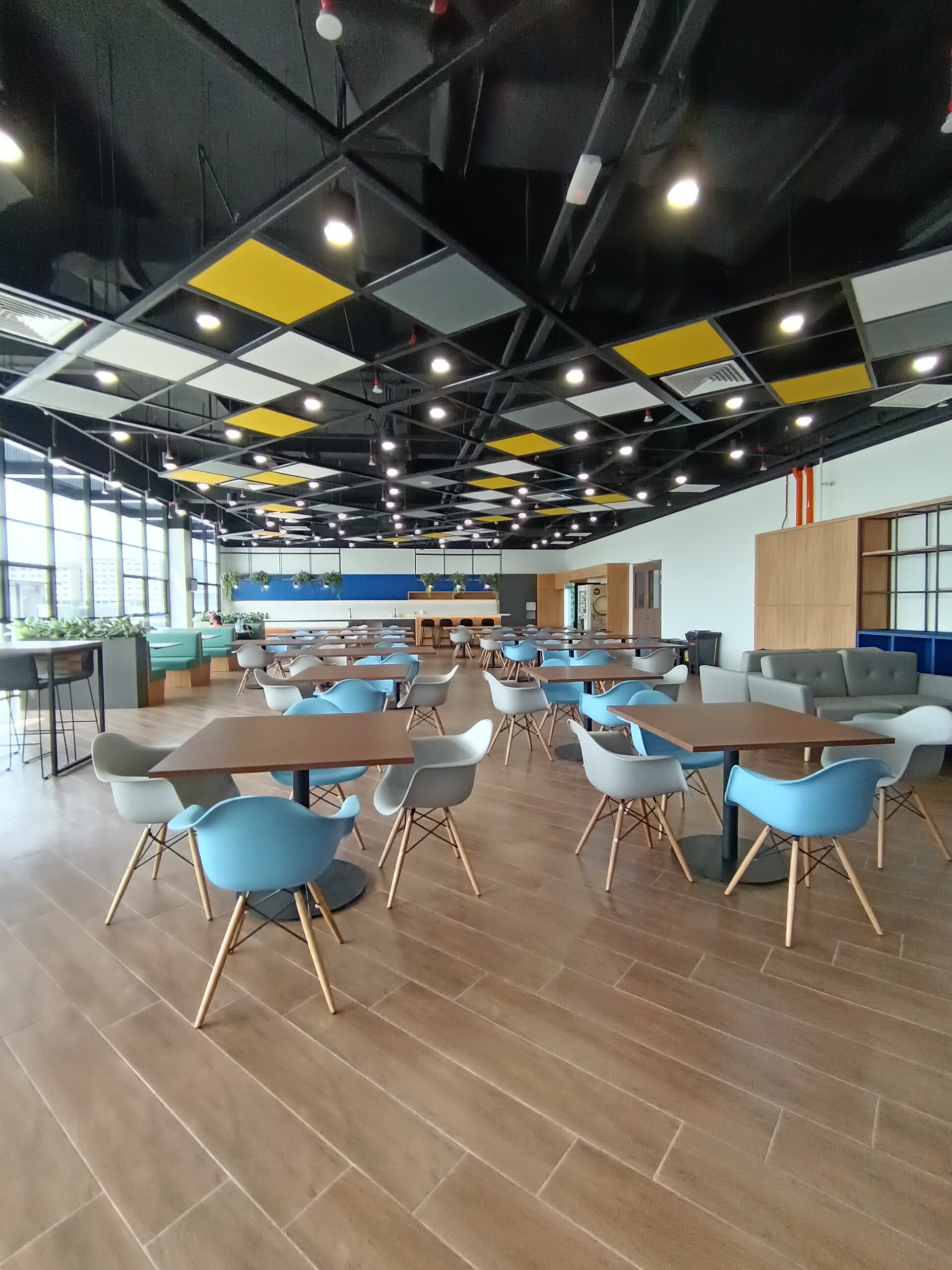
Commercial fit out cost Malaysia: real-world budget execution by IFOI.
Why Commercial Fit Out Cost Is a Strategic Decision
Every line item in a fit-out budget affects a business outcome:
- Capex vs. Opex tradeoffs — durable materials cost more upfront but reduce 5-year refurbishment cycles
- Tenancy commencement — driven by realistic timeline scoping, not optimistic ones
- Variation order exposure — shaped entirely by quotation specificity at contract stage
- Compliance risk — determined by whether CIDB and Bomba scopes are in or out
Commercial owners who treat commercial fit out budget Malaysia with the same rigour as their P&L are the ones who avoid mid-project cash-flow surprises. See how this discipline scales across project types in IFOI’s commercial interior design portfolio.
2026 Commercial Fit Out Cost Malaysia: Per-Sqft Benchmarks
The figures below reflect turnkey design-and-build rates for the Klang Valley and Johor Bahru as of early 2026. Premium addresses (KLCC, Pavilion, Iskandar Puteri waterfront) typically sit at the higher end due to after-hours work permits and stricter building management requirements.
| Space Type | Standard (RM/sqft) | Premium (RM/sqft) | Typical Duration |
|---|---|---|---|
| Corporate Office | RM 120 – 180 | RM 200 – 280 | 6 – 12 weeks |
| Retail Shop / Boutique | RM 150 – 220 | RM 250 – 350 | 4 – 8 weeks |
| F&B Outlet (Café/Restaurant) | RM 200 – 320 | RM 350 – 500 | 8 – 14 weeks |
| Showroom / Sales Gallery | RM 180 – 280 | RM 300 – 450 | 6 – 10 weeks |
| Hospitality (Hotel/Resort) | RM 300 – 450 | RM 500 – 800+ | 16 – 36 weeks |
Rates exclude loose furniture, AV equipment, and FF&E unless explicitly scoped. For office-specific deep-dive numbers, see the 2026 Office Renovation Cost Malaysia guide.
7 Budget Principles That Protect Commercial Fit Out ROI
1. Allocation
Resolve how the budget splits across M&E, carpentry, finishes, and FF&E before design begins. M&E typically absorbs 25–40% on commercial projects — far more than most first-time owners expect. Allocation is the difference between a project that delivers and one that runs out of money at finishing stage.
2. Unit Condition
Bare shell, warm shell, reinstated, and “as-is” handovers each carry different starting costs. The same 2,000 sqft unit can swing 30% in total fit-out cost depending on what condition it’s handed over in. Always confirm handover state in writing before signing the tenancy agreement — never after.
3. Compliance Scope
DBKL or MBJB approvals, Bomba submission, and change-of-use applications need to be priced explicitly. Quotations that omit compliance scope create the most expensive variation orders in commercial renovation Malaysia projects.
4. Quotation Specificity
A single line of “M&E works — RM XX,XXX” is a red flag. Reputable quotations break out partition linear metres, fixture counts, ACMV BTU, and lighting points. Unit-rated quotations protect the owner; lump-sum quotations protect the contractor.
5. Material Specification
In commercial fit out Malaysia, materials must perform under daily commercial loading — not just look good at handover. Sintered stone over engineered quartz in F&B, contract-grade upholstery in retail, and Grade A glass partitions in offices. Residential-grade specifications fail within 12–18 months under commercial use.
6. Project Size Economics
Counter-intuitively, smaller commercial projects often cost more per square foot than larger ones because fixed mobilisation, design, and submission costs are spread over fewer square feet. Projects under 1,000 sqft typically carry a 15–25% per-sqft premium versus 5,000 sqft equivalents.
7. Contingency Discipline
For a well-scoped commercial fit-out, allow 5–10% contingency. For projects involving heritage buildings, complex change-of-use, or unclear handover conditions, allow 10–20%. Contingency that isn’t budgeted upfront becomes a financing problem mid-build.
Where the Money Goes: Budget Allocation by Space Type
One of the most useful exercises before talking to any contractor is understanding how a typical commercial fit-out budget actually breaks down. Allocations vary dramatically by space type — which is why “RM 200 psf” tells you almost nothing without context.
Office Fit Out Budget Split
- Carpentry & partitions: 25–30%
- M&E (mechanical, electrical, ACMV): 25–35%
- Flooring & ceiling: 12–18%
- Built-in furniture: 10–15%
- Finishes (paint, glass, wallpaper): 8–12%
- Design fees, PM, permits: 5–10%
F&B Fit Out Budget Split
- Kitchen equipment & exhaust: 25–35% (the biggest swing factor)
- M&E with grease trap, gas, ventilation: 20–25%
- Carpentry, bar, seating: 20–25%
- Finishes & lighting: 12–18%
- Façade & signage: 5–8%
- Permits & Bomba compliance: 3–5%
F&B is where most first-time owners blow their budgets. They price the dining room but underestimate kitchen, exhaust, and ventilation. Deeper sub-vertical guidance is in the Café Interior Design Malaysia guide.
Retail Fit Out Budget Split
- Shopfront, façade, signage: 15–20%
- Display fixtures & custom carpentry: 25–35%
- Lighting (the silent retail hero): 12–18%
- Flooring & ceiling: 10–15%
- M&E, security, POS infrastructure: 15–20%
- Branding & finishes: 8–12%
Hidden Costs That Sink Commercial Fit Out Budgets
- After-hours work surcharges — KLCC, Pavilion, Mid Valley, IOI City Mall require after-10pm work, adding 15–25% to labour
- Building management deposits — refundable renovation deposits of RM 5,000–30,000 plus non-refundable processing fees
- Bomba submission — 4–8 weeks and RM 8,000–25,000 for fire-rated partition or sprinkler modifications
- Hacking and disposal — RM 8–15 per sqft for demolition of previous fit-outs
- ACMV capacity upgrades — F&B and dense offices often exceed building-standard BTU provision
- Dilapidation reports — RM 3,000–8,000 at start and end of tenancy, mandated by most landlords
- FF&E exclusions — loose chairs, sofas, AV, and decorative items are usually not in fit-out quotations
Bare-Shell vs. Partially-Fitted: How Unit Condition Changes Cost
One of the largest single variables in fit out price per sqft Malaysia is the condition of the unit at handover.
- Bare shell — concrete floor, exposed ceiling, no MEP rough-in. Add RM 40–80 psf to any benchmark above.
- Warm shell — basic ceiling, lighting, ACMV, floor screed in place. Most common starting point.
- Reinstated unit — previous tenant’s fit-out removed back to warm-shell condition. Saves on hacking but may need remedial works.
- “As-is” handover — inheriting previous tenant’s fit-out. Cheapest only if the layout works — usually adds RM 30–60 psf in modifications.
Budget Allocation Mistakes That Kill Commercial ROI
- Over-spending on visible finishes — luxury wall treatments while ACMV runs under-capacity
- Under-budgeting M&E — the single most common cost overrun on commercial fit outs
- No stress-test on the cheapest quote — under-scoped quotations turn into 25%+ variation orders
- Ignoring after-hours surcharges — premium-mall projects fail to budget the night-work premium
- Treating contingency as optional — projects without contingency stop mid-build when surprises arrive
- Compliance scoped at the end — DBKL and MBJB submissions missed at concept stage cause delayed openings and expensive variations
IFOI’s Approach to Commercial Fit Out Budgeting
Interiors Fit Out Industry (IFOI) is a CIDB-registered design-and-build firm with 26 years of commercial fit-out experience across Malaysia, Singapore, Thailand, and Indonesia. Every project starts with a budget brief — capex ceiling, capex flexibility, opex priorities, and ROI horizon — before a single design line is drawn.
IFOI manages DBKL and MBJB submissions, M&E coordination, ACMV capacity verification, and Bomba requirements in-house — no subcontracted gaps, no compliance surprises at handover. Completed commercial work spans Ritz-Carlton, Mandarin Oriental, Hilton, 7-Eleven, Apple, Starbucks, and McDonald’s. See the full project portfolio and commercial interior design capabilities.
Frequently Asked Questions
How much does a commercial fit out cost in Malaysia in 2026?
A commercial fit out in Malaysia typically costs between RM 120 and RM 600 per square foot in 2026. Offices range from RM 120–280 psf, retail RM 150–350 psf, F&B RM 200–500 psf, and hospitality RM 300 to over RM 800 psf depending on finish quality, location, and unit condition.
Which commercial space type is cheapest to fit out?
Standard offices in shoplots or warm-shell business park units are typically the lowest cost per sqft, starting from around RM 120 psf with basic finishes. F&B is consistently the most expensive due to kitchen and ventilation requirements.
How much contingency should I budget for variation orders?
For a well-scoped commercial fit out, allow 5–10% contingency. For projects involving heritage buildings, complex change-of-use, or unclear handover conditions, allow 10–20%. Contingency that isn’t planned upfront becomes a financing problem mid-build.
Can I phase a commercial fit out to spread the cost?
Yes, but it usually costs more in total. Phasing typically adds 10–18% versus a single-phase build because of repeated mobilisation, dust protection, and overlapping access constraints. It can still make sense if cash flow is the binding constraint.
How long does authority approval take in Malaysia?
Bomba submissions typically take 4–8 weeks. DBKL and other local authority approvals for change-of-use can take 8–16 weeks. These timelines cannot be compressed by paying more — they must be planned into the tenancy commencement date.
Do I need a CIDB-registered contractor?
CIDB registration is mandatory for construction projects above RM 500,000 in Malaysia. Below this threshold it is not legally required but is strongly recommended for compliance, insurance, and warranty reasons. Verify any contractor’s status at the CIDB CIMS portal.
Is SST included in fit out quotations?
SST at the prevailing rate applies to construction services in Malaysia. Always confirm whether the quotation is SST-inclusive or exclusive — this is a 6–8% difference that materially changes total project cost.
Can IFOI handle both design and construction?
Yes. IFOI is a CIDB-registered design-and-build firm — concept through to compliant handover under one contract, one project manager, one accountable party. Review completed work in the project portfolio.
Plan Your Commercial Fit Out Budget With Confidence
The difference between a commercial fit-out that delivers ROI and one that drains capital usually comes down to budgeting decisions made before any work begins — not the design choices that follow.
If you’re scoping a commercial fit out in Kuala Lumpur, Johor Bahru, Penang, or anywhere across Malaysia and Singapore, contact Interiors Fit Out Industry (IFOI) for a free consultation. With 26 years of CIDB-registered experience and a portfolio that includes Ritz-Carlton, Mandarin Oriental, 7-Eleven, Apple, and Starbucks, IFOI helps owners build realistic budgets before committing to a tenancy.