Key Takeaways: Fit Out vs Renovation
- The Core Difference: A fit out turns an empty or shell space into a usable one. A renovation changes or upgrades a space that already functions.
- Starting Condition Decides It: Bare unit or new lease → fit out. Existing, occupied, dated space → renovation.
- Malaysian Offices Use CAT A / CAT B: Landlords deliver a CAT A base; tenants commission a CAT B fit out to brand and configure it.
- Compliance Differs: Both may need DBKL/MBJB and Bomba approval; renovations touching structure need extra authority sign-off.
- One Partner, Either Path: Interiors Fit Out Industry (IFOI) is a CIDB Grade G5 design-and-build firm handling both, design through compliant handover.
Fit out vs renovation is the first decision that shapes your budget, timeline, and authority submissions — yet the two terms are used interchangeably across most quotations, which leads to mispriced scopes and delayed openings. In short: a fit out makes a new or empty space ready for use, while a renovation alters a space that already works. This guide explains the difference, when each applies in Malaysia, and how the cost, timeline, and compliance change with your choice.
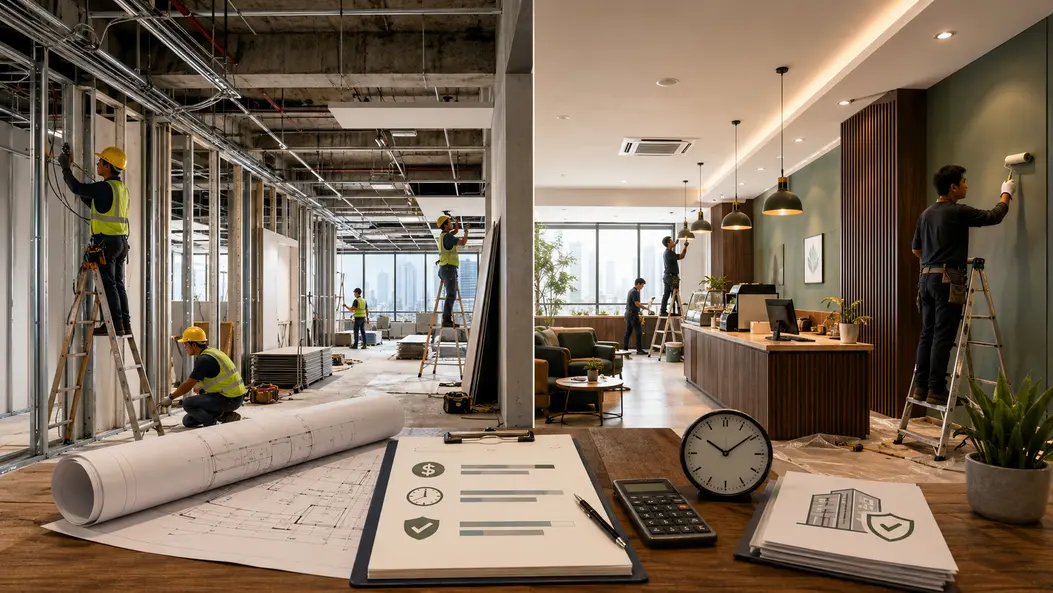
Fit out vs renovation: the starting condition of the space decides which one you need.
What Is a Fit Out?
A fit out is the process of taking a bare, shell, or newly leased space and installing everything needed to make it functional and brand-ready — flooring, ceilings, partitions, lighting, mechanical and electrical (M&E) services, joinery, fixtures, and furniture. The space typically starts unfinished. Fit outs are most common when a business signs a new commercial lease, moves into a new development, or takes over a vacated shell unit.
There are two recognised levels in the commercial leasing market:
- CAT A (Category A): the landlord’s base delivery — raised floors, suspended ceilings, basic finishes, and primary M&E. The space is “ready to fit out” but not yet usable for a specific tenant.
- CAT B (Category B): the tenant’s fit out — partitions, workstations, meeting rooms, branding, feature finishes, and IT. This is what turns a generic floor into your office.
What Is a Renovation?
A renovation is the process of updating, repairing, reconfiguring, or modernising a space that is already finished and usable. The starting point is an existing interior — an occupied office, an ageing retail unit, a tired café — that needs refreshing rather than building from scratch. Renovations range from cosmetic (new finishes, repainting, re-flooring) to structural (removing walls, relocating wet areas, altering layouts).
Because a renovation works with what already exists, it often involves demolition or “hacking” before rebuilding — and that is where authority approvals, building condition, and hidden defects make renovation scopes harder to price than a clean fit out.
Fit Out vs Renovation: Side-by-Side Comparison
| Factor | Fit Out | Renovation |
|---|---|---|
| Starting condition | Empty / shell / CAT A base | Existing, finished, usable space |
| Goal | Make the space usable for the first time | Improve or update an existing space |
| Typical scope | M&E, ceilings, flooring, partitions, joinery, FF&E | Demolition, repairs, reconfiguration, new finishes |
| When you need it | New lease, new building, vacated shell | Ageing space, rebrand, change of use |
| Demolition / hacking | Minimal (clean base) | Often significant |
| Cost predictability | Higher (known starting point) | Lower (hidden defects, existing services) |
| Authority approvals | DBKL/MBJB, Bomba, M&E sign-off | Same, plus structural approval if walls/structure change |
| Best for | Businesses moving into a new space | Businesses staying put but upgrading |
Which One Does Your Project Need?
The fastest way to decide is to look at the condition of the space on day one:
- You just signed a lease on a bare or CAT A unit → you need a fit out.
- You’re staying in your current premises but it looks dated or no longer works → you need a renovation.
- You’re taking over a space that was previously a different business (e.g. an old retail unit becoming a café) → this is usually a renovation with fit-out elements — strip out the old, then fit out the new.
- You’re rebranding or restructuring teams in the same office → renovation, often a partial one.
For commercial projects, the choice also affects which contractor scope you tender. See how both approaches play out across sectors in IFOI’s commercial interior design work.
Cost & Timeline: How They Differ in Malaysia
A clean fit out is generally easier to price and faster to deliver because the starting point is known. A renovation carries more risk — existing wiring, plumbing, and structure can hide surprises that surface only after demolition begins.
As a broad guide for commercial work in Malaysia, basic fit outs commonly start around RM 50–80 per sq ft, mid-range RM 80–150 per sq ft, and high-specification work above RM 150 per sq ft — but the real figure depends entirely on scope, finishes, and M&E. For detailed, current numbers, see IFOI’s Office Renovation Cost Malaysia 2026 guide and Commercial Fit Out Cost Malaysia guide.
On timeline, a straightforward commercial fit out typically runs 6–12 weeks from site handover; renovations involving demolition and authority resubmissions can extend well beyond that. In both cases, timeline discipline starts with pre-construction documentation — not during the build.
Compliance: What Changes Between the Two
Both fit outs and renovations in Malaysia require local authority approval — DBKL in Kuala Lumpur or MBJB in Johor Bahru — along with Bomba (fire safety) submission and M&E coordination. The key difference: a renovation that alters structure (removing walls, changing layouts, relocating wet areas) usually triggers additional structural and building-plan approvals, and may require a registered submitting person. Engaging a CIDB-registered contractor is essential for commercial work either way.
IFOI’s Approach to Fit Out & Renovation
Interiors Fit Out Industry (IFOI) is a CIDB Grade G5 design-and-build firm, backed by the founder’s 27 years of experience, delivering commercial fit out and renovation projects across Malaysia, Singapore, Thailand, and Indonesia. Every project — whether a fresh fit out or a renovation of an occupied space — starts with an operational brief and a site assessment, so the scope is priced against reality, not assumptions.
IFOI manages DBKL and MBJB submissions, Bomba requirements, M&E coordination, and wet-area compliance in-house — no subcontracted gaps, no compliance surprises at handover. See completed work in IFOI’s project portfolio.
Frequently Asked Questions
Is a fit out the same as a renovation?
No. A fit out makes a new, empty, or shell space usable for the first time, while a renovation updates or alters a space that already functions. The difference comes down to the starting condition of the space.
What is the difference between CAT A and CAT B fit out?
CAT A is the landlord’s base delivery — raised floors, ceilings, and basic M&E that make a unit “ready to fit out.” CAT B is the tenant’s fit out, adding partitions, workstations, branding, and finishes that make the space usable for a specific business.
Is a fit out cheaper than a renovation?
Not necessarily, but a fit out is usually easier to price because the starting point is known. Renovations carry more cost risk because existing wiring, plumbing, and structure can reveal hidden issues once demolition begins.
Do I need authority approval for an office renovation in Malaysia?
Yes. Commercial renovations and fit outs require local authority approval (DBKL or MBJB), Bomba submission, and M&E sign-off. Renovations that change structure usually need additional building-plan approval and a CIDB-registered contractor.
Can IFOI handle both fit out and renovation?
Yes. IFOI is a design-and-build firm that delivers both, from concept and authority submissions through to compliant handover under one contract.
Start Your Fit Out or Renovation Project
Not sure whether your project is a fit out or a renovation? Contact Interiors Fit Out Industry (IFOI) for a site assessment and a clear, scope-matched quotation.