Should you improve the office you already occupy, or find a new one? The office relocation vs renovation Malaysia decision depends on whether your current premises can support the way your team works, what your lease and building permit, and the full cost of either route.
Do not compare a refurbishment quotation with a new office’s rent alone. Compare two workable premises and delivery scopes, including the disruption of staying, the fit-out and moving work required elsewhere, and the decisions each landlord must confirm.
This guide helps a Malaysian business prepare that comparison before commissioning a design or fit-out team. It does not promise that renovation is cheaper or that moving will be faster.
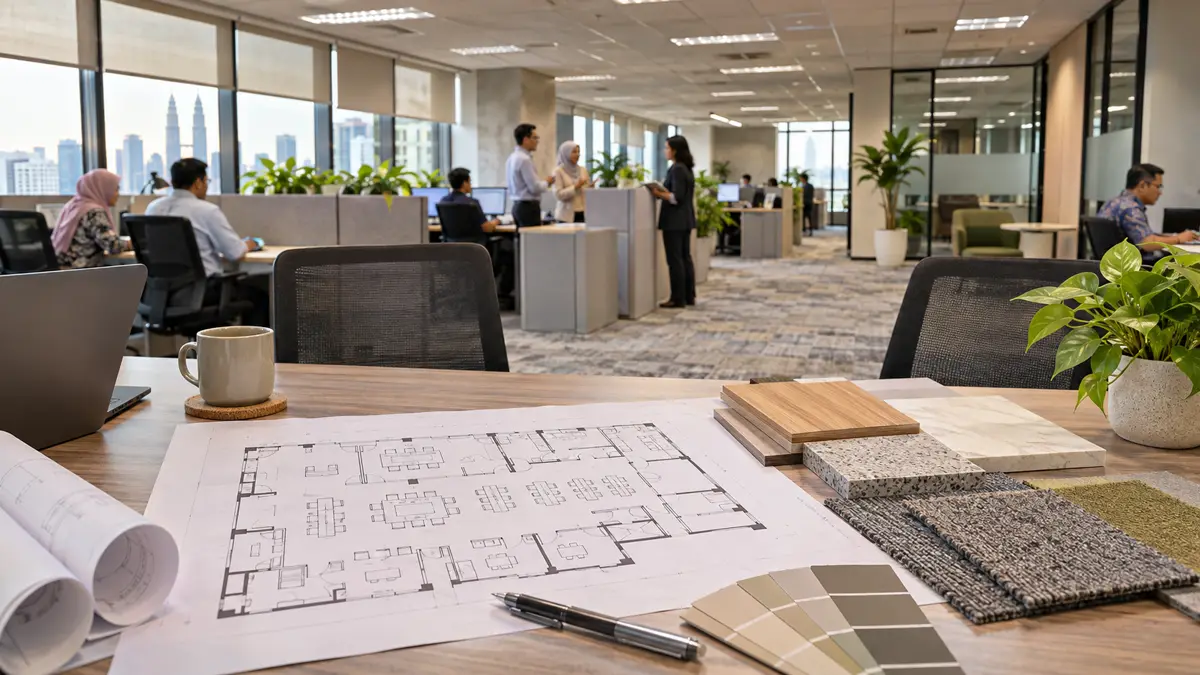
Editorial illustration of an office planning discussion; not an IFOI project photograph or a specific site survey.
Key Takeaways: Office Relocation vs Renovation Malaysia
- Start with the brief: Map headcount, work modes, meeting needs, storage and technology before choosing an address or finishes.
- Test the current unit: Ask whether its layout, services, access and lease allow the changes you need.
- Test the alternative: A new unit still needs a site survey, landlord consent and a fit-out scope.
- Compare whole-project costs: Include temporary arrangements, reinstatement, technology transfer and double occupancy where applicable.
- Protect continuity: Plan phased work or the moveover before treating either programme as feasible.
- Get comparable evidence: Commission two defined options with written assumptions, exclusions and decision owners.
IFOI’s corporate office interior design service is the owner page for the design-and-delivery conversation. First, use this decision framework to decide what both a stay option and a move option must achieve.
What Is the Real Question Behind Renovating or Relocating?
The question is which feasible premises can support your people and operations through the next stage of the business. Neither a familiar address nor a newly fitted unit solves a poor workplace brief on its own.
Write down how teams use the office today and what must change. Ask where focused work, meetings, confidential conversations, visitors, deliveries and support functions actually happen. A growing headcount may point to an area problem; it may also reveal inefficient room allocation or a hybrid attendance pattern that needs better planning rather than more floor space. Avoid treating a desk count as the entire brief.
Then separate must-haves from preferences. A client-facing office may need an accessible reception and meeting zone; an operations-heavy team may prioritise reliable data, storage, staff circulation and resilient building services. Confirm the needs with the people responsible for facilities, IT, finance and day-to-day operations rather than letting one aesthetic preference decide the premises.
Finally, set a decision date linked to the actual lease and business calendar. Ask your landlord for the current lease terms and written alteration rules, and ask a property adviser about any proposed alternative premises. This article cannot interpret your lease or establish the approvals for a particular building.
Office Relocation vs Renovation Malaysia: Quick Overview
Use this table to identify what would make each route credible, not to score a winner without site information. The evidence column is the brief you can bring to a landlord, adviser and fit-out team.
| Decision factor | Renovate current office | Relocate to another office |
|---|---|---|
| Space fit | Survey whether a revised layout meets the brief. | Test shortlisted units against the same brief. |
| Lease and landlord | Confirm tenure, alteration consent and building rules. | Confirm offer terms, access and new fit-out rules. |
| Building services | Check existing power, cooling and data capacity. | Survey actual provision, not the marketing brochure. |
| Continuity | Plan occupied works, phases or temporary space. | Plan IT changeover, staff travel and move day. |
| Total commitment | Include works, disruption and lease renewal terms. | Include fit-out, move, reinstatement and overlap. |
When Does Renovating the Existing Office Make Sense?
Renovation makes sense when the existing location still serves the business and a feasible design can remove the workplace’s actual constraints. Verify both points before assuming that remaining in place is the low-disruption choice.
A planning exercise might show that underused enclosed rooms can become flexible meeting space, or that a reception and circulation change would help visitors without adding floor area. But the idea must survive a measured survey, services review, landlord consent and a realistic programme. If the office cannot accommodate the required workstations, specialist rooms or accessibility provisions, a beautiful layout on paper is not a solution.
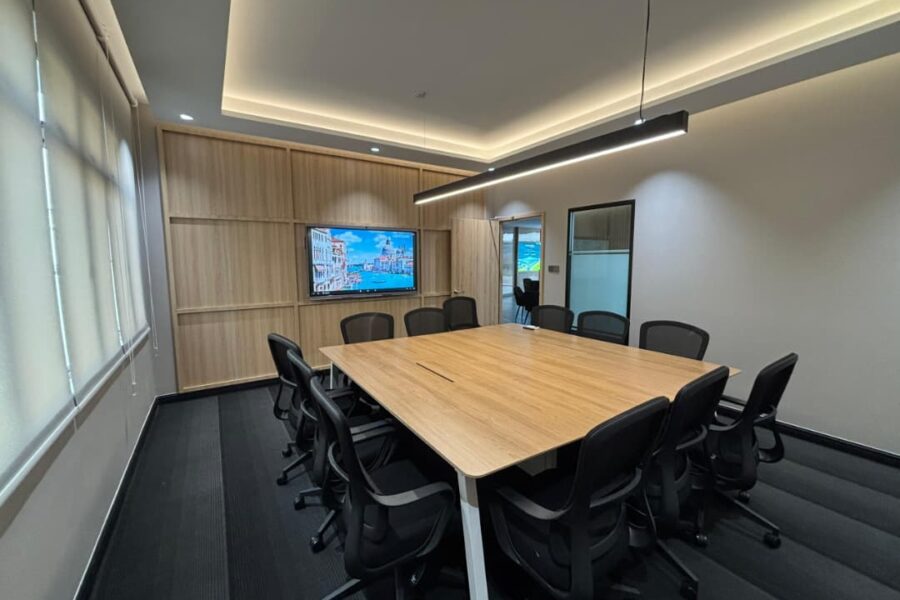
Finished meeting room from IFOI’s iPark Kuala Lumpur portfolio. Shown as an office-space example, not evidence that this project involved a renovation-versus-relocation decision.
Ask whether the current lease gives enough time to realise the investment. Check whether works trigger a reinstatement obligation at lease end, whether the landlord will approve alterations and whether building management restricts noise, deliveries or working hours. These are contract- and building-specific questions; seek written answers rather than relying on a previous tenant’s experience.
Can Work Continue During a Renovation?
It can in some projects, but only with an agreed occupied-work plan. Identify zones that must remain operational, safe access routes, air quality, noise-sensitive activities, IT downtime and the possibility of temporary decanting. Phasing can reduce a single disruptive shutdown yet increase coordination and repeated mobilisation. Ask the designer and contractor to show how staff, visitors and works will be separated.
Malaysia’s Department of Occupational Safety and Health construction-industry safety guidance stresses managing safety risks during planning and design and coordinating client, designer and builder responsibilities. It is a general safety framework, not proof that any specific occupied-office method is approved. Confirm applicable obligations with the responsible professionals for your project.
When Is Relocation the Better Option?
Relocation becomes credible when the current premises cannot meet essential needs at a reasonable scope, or when a different location materially improves access and operations. Treat a shortlisted unit as an option to test, not a finished workplace.
Consider unavoidable constraints: too little usable area, a floor plate that prevents the required layout, unsuitable building services, poor accessibility, or restrictions that block necessary changes. Another office may also serve customers or staff better. Compare travel patterns and delivery access in Johor Bahru, Kuala Lumpur or Penang according to the actual workforce and business—not a generic claim that one district is best.
Before committing, request measured plans and a survey of the candidate unit. Ask the landlord for permitted use, fit-out manual, access arrangements, service information and approval process. Check whether the space is handed over as a shell, partly fitted unit or previously occupied suite, and which existing items can lawfully and practically be reused. The apparent convenience of an already fitted office can disappear if its rooms, power and data do not fit your operation.
Also ask what happens at the old office. Lease exit, reinstatement, records disposal, furniture logistics, IT migration and communication with clients may be separate workstreams. A move is not just one contractor handing over a new interior; the business has to bridge two locations safely.
How Should You Compare the Whole Cost of Both Options?
Build two written cost schedules with the same scope assumptions and time horizon. A renovation quote and a new lease’s monthly rent are not comparable totals.
For the stay option, include survey and design, construction, furniture and technology changes, temporary workspace or staged-work costs, landlord requirements, and any negotiated lease terms. For the move option, include new fit-out, furniture, IT migration, movers, possible double occupancy, old-site reinstatement and new-site operating commitments. Ask finance and a property adviser to model the lease implications separately from the construction quotation.
List uncertain amounts as allowances with the party responsible for confirming them. Examples include whether existing power can support a revised layout, whether the old landlord requires reinstatement, and whether the new unit has usable data infrastructure. Do not turn an unverified allowance into a guaranteed saving. IFOI’s commercial fit-out cost guide
Need comparable design scopes? Bring the current and shortlisted premises information to IFOI’s corporate office interior design discussion. Ask for clearly identified assumptions, exclusions and specialist responsibilities for each feasible option.
What About Timing, Approvals and Business Continuity?
Map dependencies for both options instead of asking which route has a universally shorter construction period. The lease, site access, approvals, design decisions, procurement and IT changeover can control the actual date.
For renovation, obtain the current landlord’s alteration rules and plan any occupied work around staff and customer activity. For relocation, obtain the incoming landlord’s rules early enough to assess whether the unit can be fitted before the old lease or operating arrangement ends. Neither path should be given a calendar promise until the relevant parties have verified scope and access.
Ask who prepares drawings, who obtains landlord consent and whether the proposed changes need competent technical review or local-authority submission. Requirements vary by building and scope; do not assume that a cosmetic update and a change to partitions, electrical systems or fire-safety provisions follow the same route. The CIDB contractor-registration guidance
Create a business-continuity plan alongside the fit-out programme. Identify key dates for technology cutover, access cards, deliveries, records, client communications and a fallback if a handover task remains open. If people must work around construction, assign a site contact and agree how hazards and changes are communicated. If people move, decide who signs off the new workspace and when each team can start using it.
What Evidence Should Management Review Before Deciding?
Ask for a short decision pack rather than a persuasive rendering of only one option. It should contain the workplace brief, a measured assessment of the present office, a comparable assessment of any viable alternative, a list of permissions still outstanding, two scope-based cost schedules and the business-continuity implications of each route.
Present constraints separately from preferences. If the current building cannot provide an essential service or an acceptable occupied-work plan, that is a feasibility issue. If the new office offers a more attractive entrance but requires an unconfirmed electrical upgrade, it is not yet a fully priced solution. Mark each item as confirmed, requiring survey, awaiting landlord response or requiring specialist advice. This prevents an attractive but uncertain option from receiving the same confidence as a verified one.
Set a decision owner for lease, finance, facilities, technology and staff communications. Record who can approve a variation to the proposed scope and how the business will revisit the decision if a critical assumption changes. An office move or renovation is an operating decision as well as a design commission; the people affected by downtime and access should see the plan before a construction date is announced.
How Do You Request Comparable Proposals?
Give the same operational brief to each team and ask them to state how they will test each premises. Comparable proposals need a common definition of the rooms, people, technical interfaces and delivery constraints.
Provide current premises drawings, lease and landlord rules where available; provide equivalent documents for a shortlisted new unit. Include the intended workplace capacity, attendance pattern, meeting rooms, visitor flow, data and AV needs, furniture to retain, and target business milestones. Mark unknowns explicitly. Ask whether each proposal includes a measured survey, concept design, technical coordination, construction, move support or handover; those deliverables should not be inferred from a single price.
Have the team explain how it will treat provisional work, variations, landlord liaison, specialist services and defects. If one proposal assumes an empty unit while another prices occupied phased construction, request a revised scope before comparing totals. The office renovation checklist
IFOI’s Approach to the Stay-or-Move Decision
IFOI is a Johor Bahru-based commercial interior design and fit-out business serving Malaysian commercial projects, including Kuala Lumpur and Penang. A useful first conversation starts with the workplace brief and the actual premises constraints, not a predetermined answer to renovate or relocate.
For an office enquiry, IFOI can discuss spatial planning, customer and staff experience, design scope and fit-out coordination within the services agreed for the project. Lease advice, property selection and specialist approval responsibilities should be assigned to the relevant adviser, landlord or competent party rather than assumed to sit with a designer.
- Brief: Identify essential work modes, growth assumptions and operational pain points.
- Site: Test the current premises and any shortlisted alternative against the same needs.
- Scope: Clarify design, services, build, occupancy and handover assumptions.
- Decision: Compare feasible options and exclusions before committing to a route.
- Delivery: Agree project responsibilities and a site-specific programme once a route is selected.
Explore IFOI’s commercial interior project portfolio and corporate office interior design service. The generic planning image above is not evidence of a particular IFOI project.
Frequently Asked Questions About Office Relocation vs Renovation Malaysia
Is it cheaper to renovate or relocate an office in Malaysia?
Neither route is always cheaper. Renovation may avoid moving costs but can involve occupied-work phasing, temporary space and a lease commitment. Relocation can add new fit-out, moving, reinstatement and overlapping occupancy costs. Compare defined scopes over the same planning horizon, and ask finance and a property adviser to assess lease terms separately from contractor quotations.
Can we renovate while staff continue working in the office?
Sometimes, if the project team can agree safe separation, access, noise controls, service shutdowns and a workable sequence. Occupied work may need phased areas or temporary workstations, which can change cost and coordination. Ask the building manager and responsible safety professionals to review the actual method rather than assuming that a weekend schedule makes every activity safe.
What should we check before signing a new office lease?
Test the unit’s usable layout, service capacity, access, building rules and permitted fit-out against your workplace brief. Request available drawings and landlord requirements, then arrange a suitable survey and professional review. Ask a property adviser or legal professional to explain tenure, handover condition, alterations and exit terms. A fit-out concept should not substitute for lease diligence.
Does an existing fitted office remove the need for design work?
No. Existing rooms and furniture may be reusable, but their dimensions, condition, services and suitability for your team must be checked. A layout designed for the previous tenant may create poor meeting access, inadequate data provision or an unsuitable visitor route. Survey what is there, confirm what may be altered and price both retention and replacement options.
How do we compare renovation and relocation quotations fairly?
Use the same workplace brief, document each site’s conditions and require written inclusions, exclusions and assumptions. Separate design and construction from rent, moving, IT transfer, temporary workspace, landlord fees and reinstatement. Identify who will verify every provisional allowance. A cheap-looking construction figure is not a whole-project comparison if major interfaces are omitted.
Which approvals are needed to alter a Malaysian office?
The answer depends on the building, lease and proposed work. Start with written landlord or building-management rules, then ask qualified project advisers which technical reviews or authority submissions apply to changes in layout, services or safety provisions. Do not assume an approval list from another premises applies to yours, or that a contractor automatically handles every submission.
Choose a Feasible Workplace, Not Just an Address
The right answer to office relocation vs renovation in Malaysia is the option that meets the workplace brief after site, lease, technical and continuity checks. Prepare a comparable scope for both routes, name every unresolved assumption and obtain written answers before treating either a price or programme as firm.
Planning an office decision in Kuala Lumpur, Johor Bahru or elsewhere in Malaysia? Bring the brief and available premises information to IFOI for a scope discussion.